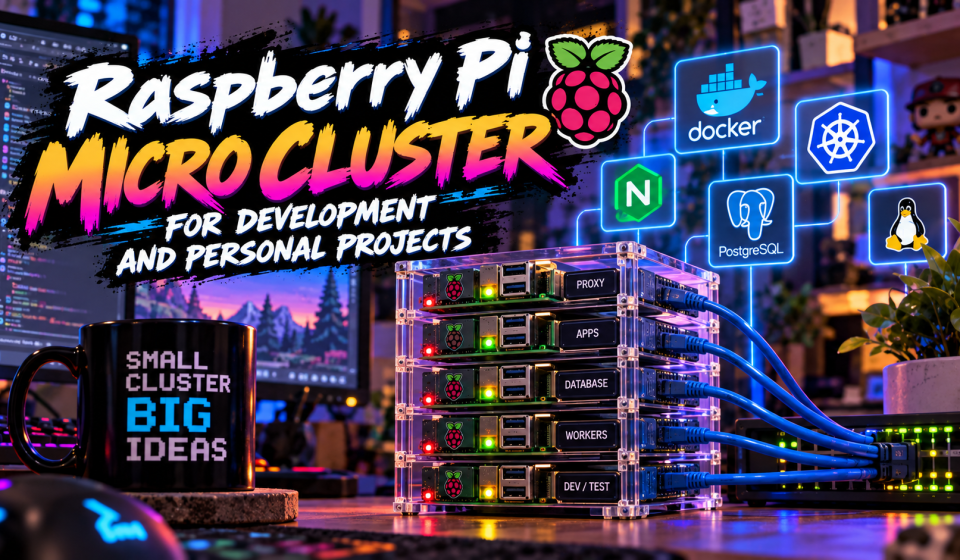

Do I need a cluster of Raspberry Pis sitting on my desk?
No.
Do I really fucking want one?
Absolutely.
I’ve always liked having my own hardware to experiment with. I already run servers, VMs, Docker containers, databases, and random services for personal projects, but there’s something incredibly appealing about having a little stack of Raspberry Pis—or similar mini computers—dedicated entirely to development and hosting my own stuff.
Would a single mini PC probably be easier?
Yes.
That’s not the point.
A Tiny Development Cluster
What I have in mind isn’t some giant homelab with racks full of servers.
I want something small.
Maybe four or five Raspberry Pis stacked together in one of those little cluster cases, connected to a small network switch, sitting quietly somewhere in my office.
Each machine could either have a dedicated purpose or become part of a small container cluster.
For example:
- Node 1: Reverse proxy and networking
- Node 2: APIs and web applications
- Node 3: PostgreSQL and other databases
- Node 4: Background services and workers
- Node 5: Testing, CI/CD, or whatever random shit I’m experimenting with that week
Would I actually keep those responsibilities separated exactly like that?
Probably not.
I’d inevitably change everything twelve times.
But that’s half the fun.
Docker Would Be a Huge Part of It
I’ve already written about why I like putting applications into Docker containers, and a little cluster like this would be a perfect playground for it.
Instead of running everything on one machine, I could experiment with distributing containers across multiple physical nodes.
Build an API on my main development machine.
Push the container.
Deploy it to the cluster.
Done.
If I screw something up?
Destroy it and redeploy it.
That’s exactly the kind of development environment I like.
And Yeah… Probably Kubernetes
I’ve joked before about developers using Kubernetes for applications that have approximately seven users.
And normally I stand by that.
But this would be different.
Not because I need Kubernetes.
Because I want to screw around with Kubernetes.
Something lightweight like K3s running across several tiny machines would give me an actual physical cluster to experiment with.
Deployments. Services. Ingress. Load balancing. Container orchestration. Node failures.
I could intentionally shut one of the machines down and see what happens.
That’s much more interesting to me than reading another Kubernetes tutorial.
Give My Projects Somewhere to Live
The other reason I’d love this setup is simply having somewhere for my personal projects to exist.
I build a lot of random stuff.
APIs.
Websites.
Game services.
Databases.
Rust experiments.
Little utilities.
Things that start with:
“I wonder if I could…”
Most of those projects don’t need AWS or Azure.
They don’t need enterprise infrastructure.
They just need a computer that’s turned on.
A tiny cluster sitting in my house would give me a permanent playground where I could deploy those projects without worrying about spinning up another cloud resource or paying another monthly bill.
Specific Hardware for Specific Jobs
There’s also something I like about giving hardware an actual job.
One little machine handles networking.
Another runs databases.
Another handles applications.
Another is where I deploy completely questionable experiments that might explode.
There’s something satisfying about being able to physically point at a computer and say:
“That’s the machine running that service.”
Could I accomplish the exact same thing with VMs?
Of course.
Could I run all of this on one reasonably powerful computer?
Absolutely.
But where’s the fun in that?
Raspberry Pi… Or Something Else?
The Raspberry Pi is the obvious choice because it’s small, relatively inexpensive, uses very little power, and has an enormous community behind it.
But I’d also be tempted by some of the other small ARM boards or inexpensive x86 mini PCs available now.
Honestly, half the project would probably be figuring out which hardware gives me the best combination of price, performance, storage, networking, and power consumption.
Because once you start buying five Raspberry Pis, power supplies, storage, cases, cooling, and a network switch…
That cheap little Raspberry Pi project can suddenly become:
“Wait… how much have I spent on this?”
Completely Unnecessary. Completely Awesome.
That’s ultimately why I want to build one.
I don’t need it.
This isn’t going to replace some massive cloud infrastructure bill.
My personal projects aren’t serving millions of requests.
A single decent mini PC could probably handle everything I want to run and barely notice.
But development isn’t always about doing things in the most efficient way possible.
Sometimes I want to build something because building it would teach me something.
I’d get to play with networking, Linux, Docker, Kubernetes, deployments, databases, monitoring, distributed applications, and physical hardware—all while giving my personal projects somewhere to live.
And at the end of it, I’d have a tiny stack of computers blinking away in my office running software I built.
Tell me that doesn’t sound fucking awesome.
Anyone running a Raspberry Pi or mini-PC cluster at home?
I’d love to hear what hardware you’re using, what you’re running on it, and—most importantly—whether you actually use the damn thing or just stare at the blinking lights like I probably would.