
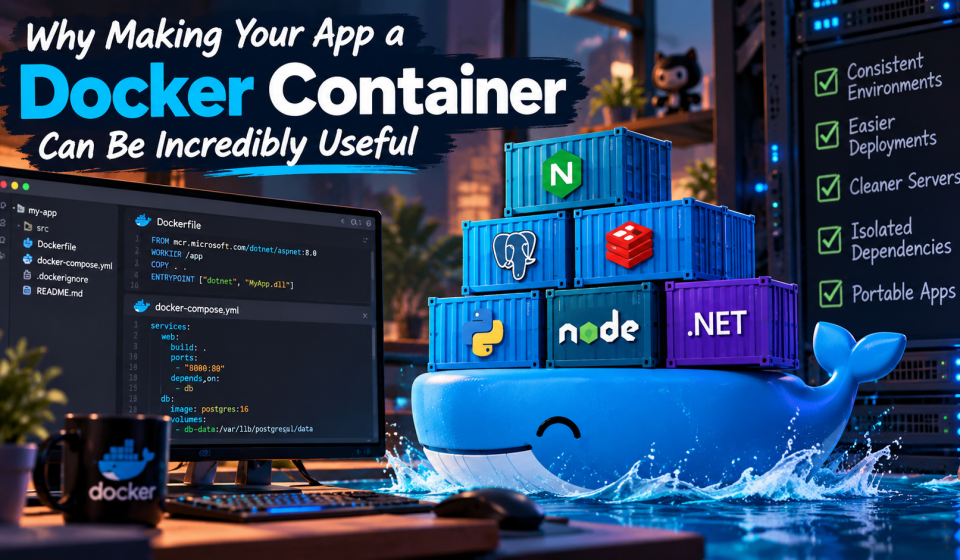

Docker is one of those technologies that can sound way more complicated than it actually needs to be.
Containers. Images. Registries. Volumes. Docker Compose. Kubernetes.
It can quickly turn into an entire rabbit hole.
But at its core, one of the things I love about Docker is incredibly simple:
I can package my application and everything it needs into one predictable little box.
And once you start doing that, it’s hard not to see the benefits.
“But It Works on My Machine”
Every developer has heard this one.
You build an application on your computer. Everything works perfectly. Then you move it to another machine and suddenly something breaks.
Wrong runtime version.
Missing dependency.
Different configuration.
Some random library you installed six months ago and completely forgot about.
Docker helps eliminate a lot of that.
Instead of saying:
Install this version of .NET, then install these packages, configure this, copy these files, and hopefully it works…
You can basically say:
Here’s the container. Run it.
The environment the application runs inside is defined along with the application itself.
That’s incredibly useful.
Deployment Becomes Much Easier
This is probably my favorite part.
Once I have an application running correctly inside Docker, moving it somewhere else becomes significantly easier.
I can develop it on my Windows machine, push the image somewhere, and run it on a completely different server.
The server doesn’t really need to care about how I originally developed the application.
It just needs to be able to run the container.
That makes deploying small APIs, web applications, background services, databases, and other tools incredibly convenient.
And if I decide to move that application to another server later?
It’s usually much less painful.
Your Server Stays Cleaner
This is something I really appreciate.
Without containers, servers can slowly become a mess.
You install one runtime for App A.
Another runtime for App B.
Then App C needs a different version.
A year later you’re looking at the server wondering:
What the hell did I install all of this for?
With Docker, those dependencies can live inside their respective containers instead.
Your host machine basically becomes the place that runs Docker rather than the place where you install every dependency for every application you have.
I find that much easier to manage.
Different Apps Can Use Different Versions
Let’s say I have two applications.
One requires one version of .NET, Node, Python, or whatever runtime I’m using.
The other requires a completely different version.
Normally that can potentially become annoying.
With Docker?
Who cares.
Each container gets its own environment.
App A can use one version while App B happily uses another.
Neither application really needs to know the other one exists.
Docker Compose Makes It Even Better
This is where Docker becomes especially nice for applications that have multiple pieces.
Maybe my application needs:
- A web frontend
- An API
- PostgreSQL
- Redis
Instead of manually configuring all of those services every time, I can describe the entire setup using Docker Compose.
Then suddenly something that sounds fairly complicated can potentially be started with:
docker compose up -d
That’s pretty damn convenient.
It also means that six months from now when I’ve completely forgotten how I configured the project, I don’t have to rely entirely on my memory.
The configuration is sitting right there with the project.
Backups and Rebuilding Become Simpler
I also like Docker because it encourages me to think about my applications as disposable.
That sounds bad, but it’s actually a good thing.
I don’t want the server itself to be special.
If that machine dies tomorrow, I don’t want to spend the next six hours trying to remember every command I ran to configure it.
Ideally, my important data lives in volumes or external storage, my configuration is backed up, and the actual application can simply be recreated from its container image.
New machine.
Install Docker.
Restore the data.
Start the containers.
Obviously reality can be a little more complicated than that, but it’s a much better situation than having years of mystery configuration living on one irreplaceable server.
It’s Great for Personal Projects Too
Docker definitely isn’t just for giant enterprise environments.
I actually think it’s incredibly useful for personal projects.
I have a machine that I use for backups, VMs, and some smaller services. Docker is perfect for that kind of setup.
If I write a little API or service that I want running continuously, I don’t necessarily want to create another VM and maintain an entire operating system just for that application.
Throw it into a container.
Give it the resources and storage it needs.
Let it run.
That’s one of the reasons I’ve become such a fan of containers.
And Then There’s Kubernetes…
Of course, eventually somebody mentions Kubernetes.
Docker containers also give you a natural path toward container orchestration platforms like Kubernetes when you actually need that level of infrastructure.
But that’s an important distinction:
when you actually need it.
You don’t need to turn your tiny personal application running on one server into a 14-node Kubernetes cluster just because you can.
Sometimes Docker Compose is perfectly fine.
Sometimes a single container is perfectly fine.
Use the complexity you actually need.
Docker Isn’t Magic
Containerizing an application doesn’t automatically make it better.
You can still create terrible Docker images.
You can still misconfigure networking.
You can still lose data if you don’t understand volumes.
And you can absolutely spend an entire evening wondering why your container can’t talk to another container because you screwed up something incredibly simple.
Ask me how I know.
But once you understand the basics, Docker becomes one of those tools that is incredibly difficult to give up.
Package It and Move On
That’s ultimately why I like using Docker.
It gives me a consistent way to package applications, deploy them, move them between machines, isolate their dependencies, and rebuild them later.
Instead of configuring an entire server around an application, I can configure the environment with the application.
For enterprise software, that’s incredibly powerful.
For a developer running random projects on a server in his house?
It’s pretty damn useful there too.



[…] already written about why I like putting applications into Docker containers, and a little cluster like this would be a perfect playground for […]
[…] I recently wrote about exactly why I’ve become such a fan of doing this in Why Making Your App a Docker Container Can Be Incredibly Useful. […]